• Are you a Tarantula hobbyist? If so, we invite you to join our community! Once you join you'll be able to post messages, upload pictures of your pets and enclosures and chat with other Tarantula enthusiasts. Sign up today!

Josh's Frogs' Tarantula Photo Thread

Josh's Frogs

Active Member
Messages
79
Location
owosso, mi
There has been a lot of restructuring of the spider known as Avicularia avicularia. The Tarantula that has always been known as the Common Pink Toe was dubbed Avicularia avicularia Morphotype One. As an adult, it is typically so dark blue as to appear nearly black. This species has a broad natural range, from Guyana to Suriname. While there is a typical look for Common Pink Toes, there is a group form Northern Guyana that retain spectacular blue color, throughout their lives. These have been termed, “The North Guyana Blue Pink Toe” but are still scientifically known as Avicularia avicularia Morphotype One. Here we see a couple of excellent examples of adult female North Guyana Blues that we keep here at Josh's Frogs.
Avicularia avicularia M1 NGB 01 - Watermarked.jpg
Avicularia avicularia M1 NGB 02 - Watermarked.jpg
 

Josh's Frogs

Active Member
Messages
79
Location
owosso, mi
Trinidad Olive Tarantulas (Neoholothele incei) are a tarantula species with some uncommon qualities. Two qualities that you do not often see in tarantulas are 1) being are shades of green and 2)being able to live with their own kind. While it is most prominent when it is a spiderling, Trinidad Olives maintain an emerald sheen throughout their lives. Here you can see a picture of one as a spiderling and another as a mature female. They also come in a gold form. Trinidad Olive Tarantulas have been successfully kept in colonies of 20+ spiders, all living together. One should be cautious when attempting to keep even communal tarantulas together. There are some species that tend to coexist peacefully, as long as nothing goes wrong. However, if anything does go wrong, the results are usually fatal.
Neoholothele incei olive Juvenile  - Watermarked 001 (1).jpg
Neoholothele incei olive - Watermarked 001 (1).jpg
 

Josh's Frogs

Active Member
Messages
79
Location
owosso, mi
Brazilian Blue tarantula This species is commonly called the Brazilian Blue Tarantula. Its scientific name was recently changed to Lasiocyano sazimai. Scientific names are often patterned after Latin. This species name, translated from Latin, means Sazima’s Hairy Blue tarantula. Lasio-(hairy)-cyano-(blue) sazimai (belonging to sazima). This species was given its species epithet, sazimai, in honor of Dr. Ivan Sazima. He was a Brazilian scientist who collected the first examples of this species. Looking at this species, it definitely earns the name, Sazima’s Hairy Blue Tarantula!
Lasiocyano sazimai WATERMARKED (1).jpg
 

Josh's Frogs

Active Member
Messages
79
Location
owosso, mi
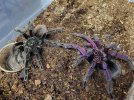
Pamphobeteus mature males are gorgeous! In most tarantula species, once a male molts out as mature, they often become straw color or drab. This is wise camouflage for males that are venturing out into the world for the first time since they left their eggsac. In many of the species of tarantulas that are in the Genus Pamphobeteus, the males don't do it like that. Instead, they opt for Vegas style fabulous! Their femurs, patellas, and tibias (the first three top visible leg segments coming out from the body) turn metallic blues, purples or pinks! Their carapace (top of their “head”) turns jet black with the same metallic color making a pattern striating out from the center. The pattern over the eyes make an arrow shape pointing toward the center. Many predators do not see well on the extreme blue end of the spectrum. Tarantulas, however, do. These electric colors created by refracting scales make them stand out to potential mates but not so much potential predators. Clever! Here is a Pamphobeteus Sp. ‘Machala’ mature male. In the next frame, compare him to his stockier, drab colored mate.
20220622_131734 - Jayzun Boget.jpg
20220622_131659 - Jayzun Boget.jpg
 

Attachments

  • 20220622_131659 - Jayzun Boget.jpg
    20220622_131659 - Jayzun Boget.jpg
    4.9 MB · Views: 18

Josh's Frogs

Active Member
Messages
79
Location
owosso, mi
Psalmopoeus pulcher is also known as the Panamanian Blonde Tarantula. Just as each breed of dog is generally known to have typical dispositions, so too do tarantulas. Psalmopoeus pulcher is known to be a very defensive species with a quick temper! The funny thing is that their scientific name translates roughly from the Latin as, “Beautiful poetic song”. Yeah, maybe if that beautiful poetic song was a terrifying battle hymn! It is an extremely pretty spider, though!
Psalmopoeus pulcher - Watermark 01 (1).jpg
 

Josh's Frogs

Active Member
Messages
79
Location
owosso, mi
Stegodyphus dufouri is also known as the Egyptian Pink Velvet Spider. This tiny beauty can be found throughout North and West Africa, including Algeria, Egypt, Libya, and Tunisia. I love the way that the pattern above their eyes makes them look like they are sorry about something. It’s as if they approach their prey and say, “I’m sorry, but I’m going to eat you now”.
Stegodyphus dufouri - Watermark 01 (1).jpg
 

Josh's Frogs

Active Member
Messages
79
Location
owosso, mi
Make Your Bed! Some tarantula species love to make their bed, literally! While some species of spider use their silk to catch their prey, tarantulas use theirs for home making and an early warning system. Here you can see three species doing just that. Here we have the Entre Rios tarantula (Grammostola iheringi), the Green Bottle Blue (Chromatopelma cyaneopubescens), and the Rear Horned Baboon Tarantula (Caratogyrus darlingi) keeping a tidy and tight home!
Grammostola iheringi - webs - Watermarked.jpg
Chromatopelma cyaneopubescens - webs - Watermarked.jpg
Ceratogyrus darlingi - Webs - Watermarked.jpg
 

Josh's Frogs

Active Member
Messages
79
Location
owosso, mi
The itsy bitsy spider!! Different species of tarantulas start out as spiderlings at various sizes. In general, species that have a greater number of eggs have smaller spiderlings. Species like the Salmon Pink Bird Eater and the Brazilian Red and White can have upwards of 2,000 eggs, but they start out as small as BBs! Also, smaller species have smaller spiderlings. Here we have a Brazilian Dwarf Pink Leg Tarantula (dwarf species), a Mexican Giant Orange Knee (250+ babies), Golden Blue Leg Baboon (smaller species), and Venezuelan Dwarf Beauty (dwarf species). We feed these spiders our smaller species of flightless fruit flies (drosophila melanogaster).
Kochiana brunnipes Sling - Watermark 01 (1).jpg
Brachypelma smithi Sling - Watermark (1).jpg

Harpactira pulchripes Sling - Watermark (1).jpg
Cyriocosmus leetzi Sling - Watermark 01 (1).jpg
 

Josh's Frogs

Active Member
Messages
79
Location
owosso, mi
This is Princess Buttercup, a King Baboon Tarantula that lives at Josh’s Frogs. This species' scientific name, “Pelenobius muticus" translates to “Silent Silk Dweller”. Pelin-(thread" or yarn) -obius(life or way of life) possibly referring to the tarantula's heavily silk lined burrows. Muticus is Latin, meaning "muted" or "silent". This is a curious choice as this tarantula is known for stridulating (making a hissing noise by rubbing body parts together) when threatened. This species is known for the females having larger, thicker back (pair number four) legs. I always thought that they reminded me of Moon Boots from the 80’s!
Pelenobius muticus - Watermarked.jpg
 

Josh's Frogs

Active Member
Messages
79
Location
owosso, mi
The Colombian Dwarf Blue Bottle Tarantula is known scientifically as Pseudhapalopus sp. 'Blue'. This species was only fairly recently discovered in 2014. Its discovery led to the discovery of quite a few, very exciting Colombian Tarantulas. These tiny gems rarely grow over three inches in diagonal leg span. This species is known for the brilliant, iridescent blues that it will be nearly covered in as adults. This individual is barely an inch and a half and is just starting to grow into its amazing adult colors.
Pseudhapalopus Sp Blue - Watermarked.jpg
 

Josh's Frogs

Active Member
Messages
79
Location
owosso, mi
One of the largest spiders in the world is the Salmon Pink Birdeater, known scientifically as Lasiodora parahybana. While this spider can achieve leg spans of 10+ inches, nothing about its common name could be called Truth in Advertising. No Salmon, no Pink, and it is not likely that they would ever eat a bird in the wild. This is Judge Judy. She is here as a mascot in the Arachnid Division of Josh’s Frogs. She is not on the breeder team because her kind have 1,500 to 3,000 babies at a time!!! We are not planning on caring for that many babies of the same species ever again!
Lasiodora parahybana AF-  Watermarked.jpg
 

Josh's Frogs

Active Member
Messages
79
Location
owosso, mi
The Guatemalan Red Rump Tarantula is known scientifically as Tliltocatl sabulosum. This species was first described in 1897 as Eurypelma sabulosum. Later, in 1989, it was moved to the genus Brachypelma, and finally, in 2020, it was formally placed into the newly established genus Tliltocatl. It has been known as the Guatemalan Red Rump Tarantula that entire time. I guess, Common Names for the win this time? ‍♂️
Tliltocatl sabulosus - Watermarked.jpg
 

Latest posts

Top