• Are you a Tarantula hobbyist? If so, we invite you to join our community! Once you join you'll be able to post messages, upload pictures of your pets and enclosures and chat with other Tarantula enthusiasts. Sign up today!

Male behaviour but no male signs (yet?)

neogold

New Member
3 Year Member
Messages
16
Location
Netherlands
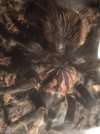
Hi, my Pampho Antinuous, roughly 3 years old, DLS over 15 cm, is consistently (over a month or so) trying to escape its enclosure.
He/she eats well, there are no tibial hooks and no other (pedipalp) signs.
I own over 50 tarantulas for a couple of years so I do know what tibial hooks look like. Also, it is of a size where IMO they should be easily visible.
Is there any other explanations for this behavior or is it a male before its last molt or ......
Wouldn't be a problem if it is a male but previous males I owned started doing this when tibial hooks were present and visible.
 

Attachments

  • IMG_20250610_220647.jpg
    IMG_20250610_220647.jpg
    3.5 MB · Views: 70

Octrej

New Member
Messages
19
Location
Baltimore, MD, USA
the behavior of trying to get out of the enclosure could be because the temperature/humidity is not right, or the enclosure is too small or too big with no hide. The picture here is also not Pamphobeteus antinous, it looks like a species of Xenesthis.
 

m0lsx

Moderator
Staff member
1,000+ Post Club
3 Year Member
Tarantula Club Member
Messages
2,490
Location
Norwich, UK
Not all species of tarantula develop tibial hooks. Although Pamphobeteus does. So it could just be waiting for it's final molt to complete the maturing process.

Another thought is. Did you get this T from a reliable source? And is it thus possible it is not a Pamphobeteus?
 

neogold

New Member
3 Year Member
Messages
16
Location
Netherlands
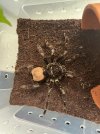
Hmm, I bought it as a sling at a reputable dealer, had my doubts as well when it turned more colorful than I expected of an antinuous. Here is a somewhat better photo. Thought it couldn't be a xenesthis as these have more spindly legs but it does look a lot like the Immanis I have - a bit more beefy but then it is a bit larger.
I don't intend to breed so n problem there but would like to know what it is.
Good news is that I have a good reason to get an antinous (again?)
 

Attachments

  • IMG_20250614_133212.jpg
    IMG_20250614_133212.jpg
    2.3 MB · Views: 75

neogold

New Member
3 Year Member
Messages
16
Location
Netherlands
the behavior of trying to get out of the enclosure could be because the temperature/humidity is not right, or the enclosure is too small or too big with no hide. The picture here is also not Pamphobeteus antinous, it looks like a species of Xenesthis.
Thanks for the reply, don't think it's humidity or environment as I have several similar sized pampho's, phormictopus end Xenesthis in the same size enclosure with same environment none of them exhibiting this behavior. You got me thinking about wether it is perhaps a Xenesthis after all (stilll doesn't explain the behavior though). Thanks again
 

Octrej

New Member
Messages
19
Location
Baltimore, MD, USA
Hmm, I bought it as a sling at a reputable dealer, had my doubts as well when it turned more colorful than I expected of an antinuous. Here is a somewhat better photo. Thought it couldn't be a xenesthis as these have more spindly legs but it does look a lot like the Immanis I have - a bit more beefy but then it is a bit larger.
I don't intend to breed so n problem there but would like to know what it is.
Good news is that I have a good reason to get an antinous (again?)
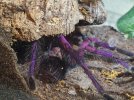
Pamphobeteus antinous is pretty much completely black, very different from Xenesthis

My Pamphobeteus antinous
IMG_2678.jpeg


Xenesthis intermedia
IMG_2748.jpeg
 

Attachments

  • IMG_2678.jpeg
    IMG_2678.jpeg
    2.2 MB · Views: 72

neogold

New Member
3 Year Member
Messages
16
Location
Netherlands
Pamphobeteus antinous is pretty much completely black, very different from Xenesthis

My Pamphobeteus antinous
View attachment 75698

Xenesthis intermedia
View attachment 75699
Originally thought the antinous would be even blacker - like a G. Pulchra .
However, found out there are a few variations so thought nothing further of it.
Now it looks more and more like a Xenesthis indeed. Not a bad thing but not what I thought to buy at the time. Thanks for showing the photos.
 

neogold

New Member
3 Year Member
Messages
16
Location
Netherlands
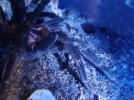
A bit off topic but fits this forum - showing the Pampho sp. Duran which molted a week ago (assuming it is as was sold this time :) ).
Used to be a very nervous hair kicker - hopefully more calm now
 

Attachments

  • IMG_20250614_134649.jpg
    IMG_20250614_134649.jpg
    5.7 MB · Views: 165

Latest posts

Top