• Are you a Tarantula hobbyist? If so, we invite you to join our community! Once you join you'll be able to post messages, upload pictures of your pets and enclosures and chat with other Tarantula enthusiasts. Sign up today!

Hi! Need community support!

StephRN

New Member
Messages
10
Location
East Bay California
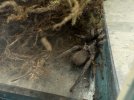
Hi, my name is Stephanie. I live in the San Francisco Bay Area in California. Last weekend, I walked into my kitchen and, SHOCKER, this little guy was chilling in the middle of my kitchen floor. I happen to have an aquarium that I had bought for another long story, so I caught him by putting a glass over him and placed him in the aquarium. I want to do what is best for him/her. Looks like a juvenile. I was thinking I could keep it through the winter/rainy season and then let it go in the summer -? Or maybe keep it if that’s not an abusive thing to do, since it came to me after all!
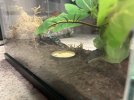
Anyway, I’m really worried about doing something wrong and traumatizing or hurting it. I’m attaching pictures of the aquarium. I have one picture of the spider. I just got the fake rock last night, but he seems to prefer the moss stuff, maybe because I put that in when I first grabbed him and he made a little nest in it right away.
 

Attachments

  • IMG_6941.jpeg
    IMG_6941.jpeg
    3.1 MB · Views: 14
  • IMG_6940.jpeg
    IMG_6940.jpeg
    2.9 MB · Views: 9
  • IMG_6939.jpeg
    IMG_6939.jpeg
    3.6 MB · Views: 14
  • IMG_7359.jpeg
    IMG_7359.jpeg
    2.8 MB · Views: 14

StephRN

New Member
Messages
10
Location
East Bay California
Hi, my name is Stephanie. I live in the San Francisco Bay Area in California. Last weekend, I walked into my kitchen and, SHOCKER, this little guy was chilling in the middle of my kitchen floor. I happen to have an aquarium that I had bought for another long story, so I caught him by putting a glass over him and placed him in the aquarium. I want to do what is best for him/her. Looks like a juvenile. I was thinking I could keep it through the winter/rainy season and then let it go in the summer -? Or maybe keep it if that’s not an abusive thing to do, since it came to me after all!
Anyway, I’m really worried about doing something wrong and traumatizing or hurting it. I’m attaching pictures of the aquarium. I have one picture of the spider. I just got the fake rock last night, but he seems to prefer the moss stuff, maybe because I put that in when I first grabbed him and he made a little nest in it right away.
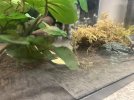
The things I’m worried about is keeping him warm enough. I keep my house pretty cold, but I figure it’s a lot warmer than outside -? The other thing is I bought this creature soil. I have more of it if I should make it deeper and I put a couple little drops of water to try to add a little moisture, but I’m not sure what to do about that or if I even need to. I don’t know how often to feed him. I got little baby crickets from the pet store and he has eaten a few of those. I’m pretty sure I only put in one at a time but I think he’s eaten at least two of them since I caught him over the weekend. Do I put another one in every time he eats one??
I’m also concerned about where I should put him. Right now he’s in my kitchen and there’s lots of noise and the counter probably gets bumped a lot so I’m wondering where I should put the aquarium for him to feel most at ease. Obviously in the living areas where the humans are and the other pets is where it’s the warmest, but it’s also the busiest.

Sincerely, appreciate any input!!
 

AndrewClayton

Well-Known Member
3 Year Member
Tarantula Club Member
The things I’m worried about is keeping him warm enough. I keep my house pretty cold, but I figure it’s a lot warmer than outside -? The other thing is I bought this creature soil. I have more of it if I should make it deeper and I put a couple little drops of water to try to add a little moisture, but I’m not sure what to do about that or if I even need to. I don’t know how often to feed him. I got little baby crickets from the pet store and he has eaten a few of those. I’m pretty sure I only put in one at a time but I think he’s eaten at least two of them since I caught him over the weekend. Do I put another one in every time he eats one??
I’m also concerned about where I should put him. Right now he’s in my kitchen and there’s lots of noise and the counter probably gets bumped a lot so I’m wondering where I should put the aquarium for him to feel most at ease. Obviously in the living areas where the humans are and the other pets is where it’s the warmest, but it’s also the busiest.

Sincerely, appreciate any input!!
The fact that it was just roaming around you're kitchen makes me think that's a mature male, get some close up photos of the pedipalps and front 2 legs, if it has bulbous tips of the pedipalps and tiny hook like structure on the underside of the 1st joint on the front 2 legs it is mature male and best course of action is to release it, they have one goal in life and that's to breed.

If it turns out not to be male or mature yet yet then, it will need a lot more substrate, it should have 1.5x it's leg span in space from surface of soil to the ceiling of enclosure.
I can't tell from those photos but it does look like some sort of Aphonopelma sp, and since you found it local to you're area then it should be absolutely fine at whatever temps you're home is at if it's warmer than outside.
Don't feed as often, when babies it's perfectly fine to feed constantly to help them grow, but as they grow you should dial back on feeding, feed a few crickets every other week, they have incredibly slow metabolism, some species commonly go a whole year without eating, I have a lasiodora parahybana just now that hasn't ate in around 6 months now. You want thier abdomen to be roughly 1.5 times the size of the carapace, if they get to big it can cause them issues and is also a hazard if they fall, plenty have died from falls and ruptured abdomen.
Put a water dish in, they can't drown and will drink straight from the water, do not use any sort of bug gel or anything, a little tub of some sort and fill it with water, that's it.
As for where to keep it, Somewhere out the road of other pets especially cats, they are apex predators and will find a way to kill it.
 

StephRN

New Member
Messages
10
Location
East Bay California
The fact that it was just roaming around you're kitchen makes me think that's a mature male, get some close up photos of the pedipalps and front 2 legs, if it has bulbous tips of the pedipalps and tiny hook like structure on the underside of the 1st joint on the front 2 legs it is mature male and best course of action is to release it, they have one goal in life and that's to breed.

If it turns out not to be male or mature yet yet then, it will need a lot more substrate, it should have 1.5x it's leg span in space from surface of soil to the ceiling of enclosure.
I can't tell from those photos but it does look like some sort of Aphonopelma sp, and since you found it local to you're area then it should be absolutely fine at whatever temps you're home is at if it's warmer than outside.
Don't feed as often, when babies it's perfectly fine to feed constantly to help them grow, but as they grow you should dial back on feeding, feed a few crickets every other week, they have incredibly slow metabolism, some species commonly go a whole year without eating, I have a lasiodora parahybana just now that hasn't ate in around 6 months now. You want thier abdomen to be roughly 1.5 times the size of the carapace, if they get to big it can cause them issues and is also a hazard if they fall, plenty have died from falls and ruptured abdomen.
Put a water dish in, they can't drown and will drink straight from the water, do not use any sort of bug gel or anything, a little tub of some sort and fill it with water, that's it.
As for where to keep it, Somewhere out the road of other pets especially cats, they are apex predators and will find a way to kill it.
Andrew!! Thank you so much! I do have a water dish in there. I’m not sure if you can see it. The first day I put him in. I also put water in there and he went straight to it and literally like sucked it up.
He seems pretty small… But I will get more pictures and absolutely will set him free if he’s full grown!!
Thank You!!
 

StephRN

New Member
Messages
10
Location
East Bay California
Andrew!! Thank you so much! I do have a water dish in there. I’m not sure if you can see it. The first day I put him in. I also put water in there and he went straight to it and literally like sucked it up.
He seems pretty small… But I will get more pictures and absolutely will set him free if he’s full grown!!
Thank You!!
I also messed up and put another cricket in there tonight, but if it’s still there in the morning, I will remove it. As soon as I can get some better pictures. I will post them. I guess the one that I did show didn’t give you enough information. I know it’s not that great. As far as the environment. If it is determined to keep him/her, I will do whatever I can to make it it’s environment. Awesome.!
 

Eighth Eye Blind

Active Member
Tarantula Club Member
Messages
158
Location
USA
It's incredibly hard to identify most species from a single picture, but I'm going to stick my neck out and say that what you've got there isn't actually a tarantula!

To me it looks like a "false tarantula" of the genus Calisoga. These are closely related to true tarantulas but don't quite make the cut. They're sort of halfway between true tarantulas and trap door spiders with a few features borrowed from each. They're pretty common in your area of California.

There are two things that make me think this:

First, you found it inside. Houses are Calisoga territory. It's not unheard of for tarantulas to invite themselves in but it's not really normal behavior for them either. Tarantulas from your part of the US tend to be pretty shy except for (as Andrew mentioned) mature males that wander around lookin' for love during the mating season. It's a little bit late in the year for males to be out on the prowl which weighs against that being a true tarantula species. It also looks way too small to be a mature male from any of the tarantulas that live in your area.

Second, the tarsi on your little friend (the most distal segments of the legs) seem a bit too long and slender for a true tarantula. Again, it's really hard to judge from a single pic but to me those tarsi are screaming Calisoga rather than tarantula.

As Andrew also suggests, more pics will definitely help. You really need good shots of all parts of the little beasty in order to tell what it is. Please post more if you can!
 

Enn49

Moderator
Staff member
1,000+ Post Club
3 Year Member
Tarantula Club Member
10 Year Member
Messages
11,229
Location
Malton, UK
Hello Stephanie, welcome. :)
It looks a though you have already got some great advice,
 

StephRN

New Member
Messages
10
Location
East Bay California
I also messed up and put another cricket in there tonight, but if it’s still there in the morning, I will remove it. As soon as I can get some better pictures. I will post them. I guess the one that I did show didn’t give you enough information. I know it’s not that great. As far as the environment. If it is determined to keep him/her, I will do whatever I can to make it it’s environment. Awesome.!
Found this on AI


Aphonopelma steindachneri, commonly known as Steindachner's Ebony ...


The primary tarantula species native to San Ramon, California, and the surrounding Tri-Valley area is the California desert tarantula (Aphonopelma iodius), also locally known as the Bay Area blond tarantula. [1, 2, 3]
While historical records and casual observers occasionally group local sightings under Aphonopelma eutylenum or Aphonopelma chalcodes, modern taxonomic consensus identifies the San Francisco Bay Area's endemic population as Aphonopelma iodius. [1, 2]

Local Distribution & Habitat
    • Prime Viewing Areas. You are most likely to spot them in the open grasslands, chaparral, and oak woodlands surrounding San Ramon, especially in nearby Mount Diablo State Park, Del Valle Regional Park, and Sunol Regional Wilderness. [1, 2, 3]
    • Subterranean Lifestyle. Both males and females spend nearly their entire lives underground in silk-lined burrows, emerging primarily at night to ambush crickets, beetles, and other small arthropods. [1, 2]

Seasonal Activity & Behavior
    • Fall Mating Season. Sightings peak from late August through early November, with the highest activity typically occurring around mid-October. During this window, mature males (around 4 to 7 years old) leave their burrows permanently and wander across trails and roads at dusk in search of female burrows. [1, 2, 3, 4]

Andrew pretty much nailed it but if it's male it's very important to let him go about his business.
OK guys so it seems to be pretty active at night because it looks like he moves his Mossy stuff around. I haven’t actually seen it out and about since I added the dirt and stuff night before last.
Please let me know - How do I get, let’s say HER for arguments sake :), out of her house so I can both take a picture to verify it’s not a male and also add more dirt to the aquarium without traumatizing it.Every time I move the moss It has to build another web house.
I’d love to get all of that done sooner than later, so I can either let him go or make her a comfy living space.
Thank you, thank you thank you!
 

StephRN

New Member
Messages
10
Location
East Bay California
It's incredibly hard to identify most species from a single picture, but I'm going to stick my neck out and say that what you've got there isn't actually a tarantula!

To me it looks like a "false tarantula" of the genus Calisoga. These are closely related to true tarantulas but don't quite make the cut. They're sort of halfway between true tarantulas and trap door spiders with a few features borrowed from each. They're pretty common in your area of California.

There are two things that make me think this:

First, you found it inside. Houses are Calisoga territory. It's not unheard of for tarantulas to invite themselves in but it's not really normal behavior for them either. Tarantulas from your part of the US tend to be pretty shy except for (as Andrew mentioned) mature males that wander around lookin' for love during the mating season. It's a little bit late in the year for males to be out on the prowl which weighs against that being a true tarantula species. It also looks way too small to be a mature male from any of the tarantulas that live in your area.

Second, the tarsi on your little friend (the most distal segments of the legs) seem a bit too long and slender for a true tarantula. Again, it's really hard to judge from a single pic but to me those tarsi are screaming Calisoga rather than tarantula.

As Andrew also suggests, more pics will definitely help. You really need good shots of all parts of the little beasty in order to tell what it is. Please post more if you can!
Oh that’s interesting! Yes, it does seem small for a tarantula but definitely not a wolf. Spider and AI did say tarantula. I agree it seems small, from my ignorant perspective, for a full grown male. I am familiar with false widows, but I didn’t know about false tarantulas. I will definitely be doing what I can as soon as I can to get more photos. Is everyone cool if I keep it if it’s not a male tarantula –?
 

StephRN

New Member
Messages
10
Location
East Bay California
Oh that’s interesting! Yes, it does seem small for a tarantula but definitely not a wolf. Spider and AI did say tarantula. I agree it seems small, from my ignorant perspective, for a full grown male. I am familiar with false widows, but I didn’t know about false tarantulas. I will definitely be doing what I can as soon as I can to get more photos. Is everyone cool if I keep it if it’s not a male tarantula –?
I showed the picture to AI and it seems to think it’s definitely a tarantula. It sounds like it’s almost positively an adult male in which case I would, of course want to safely release it as soon as possible. With that mind should I go ahead and pull up? It’s moss to get him into a glass so I can look further?
 

AndrewClayton

Well-Known Member
3 Year Member
Tarantula Club Member
Found this on AI


View attachment 78056


The primary tarantula species native to San Ramon, California, and the surrounding Tri-Valley area is the California desert tarantula (Aphonopelma iodius), also locally known as the Bay Area blond tarantula. [1, 2, 3]
While historical records and casual observers occasionally group local sightings under Aphonopelma eutylenum or Aphonopelma chalcodes, modern taxonomic consensus identifies the San Francisco Bay Area's endemic population as Aphonopelma iodius. [1, 2]

Local Distribution & Habitat
    • Prime Viewing Areas. You are most likely to spot them in the open grasslands, chaparral, and oak woodlands surrounding San Ramon, especially in nearby Mount Diablo State Park, Del Valle Regional Park, and Sunol Regional Wilderness. [1, 2, 3]
    • Subterranean Lifestyle. Both males and females spend nearly their entire lives underground in silk-lined burrows, emerging primarily at night to ambush crickets, beetles, and other small arthropods. [1, 2]

Seasonal Activity & Behavior
    • Fall Mating Season. Sightings peak from late August through early November, with the highest activity typically occurring around mid-October. During this window, mature males (around 4 to 7 years old) leave their burrows permanently and wander across trails and roads at dusk in search of female burrows. [1, 2, 3, 4]


OK guys so it seems to be pretty active at night because it looks like he moves his Mossy stuff around. I haven’t actually seen it out and about since I added the dirt and stuff night before last.
Please let me know - How do I get, let’s say HER for arguments sake :), out of her house so I can both take a picture to verify it’s not a male and also add more dirt to the aquarium without traumatizing it.Every time I move the moss It has to build another web house.
I’d love to get all of that done sooner than later, so I can either let him go or make her a comfy living space.
Thank you, thank you thank you!
Honestly, just leave it. The fact it has went ahead and started to make a home basically confirms it's not a mature male (it obviously could still be male just not mature yet)
Going back and looking at the pics you did upload though I'm swaying now to what @Eighth Eye Blind said. Are we absolutely positive it is a Tarantula. I think that's where we need to start here. I never knew of any the species they spoke about but upon researching them it's made me unsure. My 1st thoughts with location was obviously an Aphonopelma species.
Oh that’s interesting! Yes, it does seem small for a tarantula but definitely not a wolf. Spider and AI did say tarantula. I agree it seems small, from my ignorant perspective, for a full grown male. I am familiar with false widows, but I didn’t know about false tarantulas. I will definitely be doing what I can as soon as I can to get more photos. Is everyone cool if I keep it if it’s not a male tarantula –?
Males of some species can be incredibly small compared to the female, sometimes the female can be up to 5x the size of the mature male with certain species.
I showed the picture to AI and it seems to think it’s definitely a tarantula. It sounds like it’s almost positively an adult male in which case I would, of course want to safely release it as soon as possible. With that mind should I go ahead and pull up? It’s moss to get him into a glass so I can look further?
AI is a fantastic tool, but it's just that, a tool, you still have to do the actual research. It gets stuff wrong all the time especially with images, as can be seen with the 6 finger humans it creates.


So without digging it up, can you compare it's leg span from a photo or memory to some object we will all know the size of, it's obviously not going to be an exact leg span measurement but it gives an idea of the rough size it could be.

In short, if it is indeed a Tarantula and not a mature male or even male there is absolutely no point in digging it out. It's made it's home and you are as well just keeping it as you do seem to care for the spider.

We do however have to get some ID on it though, purely for care purposes. If it has made a burrow and you can see an entrance, try using a long blade of grass or something similar to rub around the entrance to see in you can entice it out the burrow for some more pics, also see if you're camera has a macro mode, it lets you get close up photos, you have to be close to the spider though so if you're not comfortable doing that just get normal photos, we don't want you accidentally dropping a phone on it.

Keep us updated.
 

Eighth Eye Blind

Active Member
Tarantula Club Member
Messages
158
Location
USA
My 1st thoughts with location was obviously an Aphonopelma species.
One easy way to tell if it's a Calisoga is to piss it off and let it bite you.

Calisoga venom isn't quite up to the level of an old world species, but it does command much greater respect than the wimpy nibble of an Aphonopelma. I've never taken a hit from one, but people I know say that it's more like a hornet string than the typical honey bee pain that a new world species deals out.

It's not, of course, the recommended way to distinguish the genus but it will get the job done in a pinch (pun intended).

AI is a fantastic tool, but it's just that, a tool, you still have to do the actual research. It gets stuff wrong all the time
^^^ This.

Spider taxonomy is one of the most difficult subjects there is. Humans can't agree on a lot of it. AI is 90% useless for this kind of thing (at least until it gets much. much more training on the subject).

As an example, there was a species of California tarantula first identified in the 1870's and named Eurypelma californicum. People studied these for decades - well into the 2000's, in fact - and they became something of a standard model for looking at the circulatory system of spiders.

Well, it turns out there's no such thing as a Eurypelma californicum. Somebody took a closer look about fifteen years ago and realized that what everybody was calling E. californicum was actually just a local variant of the species Aphonopelma hentzi - one of the most common tarantulas in the US. Several hundred research papers now have to be reevaluated to try and straighten it all out.

Experts in the field blew the ID on E. californicum for 140 years. There's no way anybody should trust AI about tarantula taxonomy. It'll be another decade or two before AI is smart enough to figure it out.
 

StephRN

New Member
Messages
10
Location
East Bay California
One easy way to tell if it's a Calisoga is to piss it off and let it bite you.

Calisoga venom isn't quite up to the level of an old world species, but it does command much greater respect than the wimpy nibble of an Aphonopelma. I've never taken a hit from one, but people I know say that it's more like a hornet string than the typical honey bee pain that a new world species deals out.

It's not, of course, the recommended way to distinguish the genus but it will get the job done in a pinch (pun intended).


^^^ This.

Spider taxonomy is one of the most difficult subjects there is. Humans can't agree on a lot of it. AI is 90% useless for this kind of thing (at least until it gets much. much more training on the subject).

As an example, there was a species of California tarantula first identified in the 1870's and named Eurypelma californicum. People studied these for decades - well into the 2000's, in fact - and they became something of a standard model for looking at the circulatory system of spiders.

Well, it turns out there's no such thing as a Eurypelma californicum. Somebody took a closer look about fifteen years ago and realized that what everybody was calling E. californicum was actually just a local variant of the species Aphonopelma hentzi - one of the most common tarantulas in the US. Several hundred research papers now have to be reevaluated to try and straighten it all out.

Experts in the field blew the ID on E. californicum for 140 years. There's no way anybody should trust AI about tarantula taxonomy. It'll be another decade or two before AI is smart enough to figure it out.
yeah… sounds about like CALIFORNIA!!
 

StephRN

New Member
Messages
10
Location
East Bay California
Honestly, just leave it. The fact it has went ahead and started to make a home basically confirms it's not a mature male (it obviously could still be male just not mature yet)
Going back and looking at the pics you did upload though I'm swaying now to what @Eighth Eye Blind said. Are we absolutely positive it is a Tarantula. I think that's where we need to start here. I never knew of any the species they spoke about but upon researching them it's made me unsure. My 1st thoughts with location was obviously an Aphonopelma species.

Males of some species can be incredibly small compared to the female, sometimes the female can be up to 5x the size of the mature male with certain species.

AI is a fantastic tool, but it's just that, a tool, you still have to do the actual research. It gets stuff wrong all the time especially with images, as can be seen with the 6 finger humans it creates.


So without digging it up, can you compare it's leg span from a photo or memory to some object we will all know the size of, it's obviously not going to be an exact leg span measurement but it gives an idea of the rough size it could be.

In short, if it is indeed a Tarantula and not a mature male or even male there is absolutely no point in digging it out. It's made it's home and you are as well just keeping it as you do seem to care for the spider.

We do however have to get some ID on it though, purely for care purposes. If it has made a burrow and you can see an entrance, try using a long blade of grass or something similar to rub around the entrance to see in you can entice it out the burrow for some more pics, also see if you're camera has a macro mode, it lets you get close up photos, you have to be close to the spider though so if you're not comfortable doing that just get normal photos, we don't want you accidentally dropping a phone on it.

Keep us updated.
Definitely comfortable doing it. I won’t be reckless, but have been the bug, reptile, etc. lover in my family since birth. I had my hand in there, carefully, the other night when I was setting up the aquarium, and I’m not someone who is jumpy. My bigger concern is the spider…. I think I could entice it out. in the meantime, I will put a reference item against the same area in the aquarium where I took the original picture and maybe that will give us an idea of its size. I was also thinking I could set up some sort of a camera.

Again, thank you so much. I’m so glad I found this community!
 

Latest posts

Top